恒星的生命、时代与死亡

镜像快照 · 2026-11-05 · 查看 NASA 原文 ↗

我们中有谁路过小报时不会偷偷瞄一眼标题呢?但如果你真的在寻找一个戏剧性的故事,也许该把注意力从好莱坞的明星转向real thing。从诞生到死亡,这些燃烧的气体球体会经历我们宇宙中最极端的一些环境。

This visualization provides a three-dimensional perspective on Hubble's image of the nebula Gum 29 with the star cluster Westerlund 2 at its core. The flight traverses the foreground stars and approaches the lower left rim of the nebula Gum 29. Passing through the wispy darker clouds on the near side, the journey reveals bright gas illuminated by the intense radiation of the newly formed stars of cluster Westerlund 2. Within the nebula, several pillars of dark, dense gas are being shaped by the energetic light and strong stellar winds from the brilliant cluster of thousands of stars.
一段飞入星云Gum 29及其核心星团Westerlund 2的可视化影像。NASA、ESA、G. Bacon、L. Frattare、Z. Levay 和 F. Summers(Viz3D团队,STScI),以及 J. Anderson(STScI)

所有恒星都诞生于尘埃和气体云中,就像下图鹰状星云(Eagle Nebula)里的Pillars of Creation一样。在这些stellar nurseries中,气体会聚成团,随着时间推移吸引越来越多的质量。随着它们长大,这些团块开始旋转并升温。一旦它们变得足够重、足够热(比如2700万华氏度或
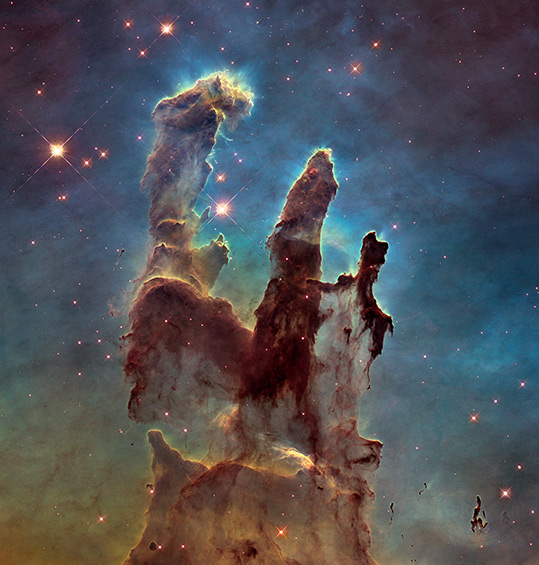
On a background awash in blue and orange cloudy light stands a darker cloud with three pillars rising from it. The edges of the dark regions glow with white and light-blue light.
These tendrils of cosmic dust and gas sit at the heart of M16, or the Eagle Nebula. The aptly named Pillars of Creation, featured in these stunning Hubble images, are part of an active star-forming region within the nebula and hide newborn stars in their wispy columns.
NASA, ESA, and the Hubble Heritage Team (STScI/AURA)

From then on, stars’ life cycles depend on how much mass they have. Scientists typically divide them into two broad categories: low-mass and high-mass stars. (Technically, there’s an intermediate-mass category, but we’ll stick with these two to keep it straightforward!)

Low-mass stars

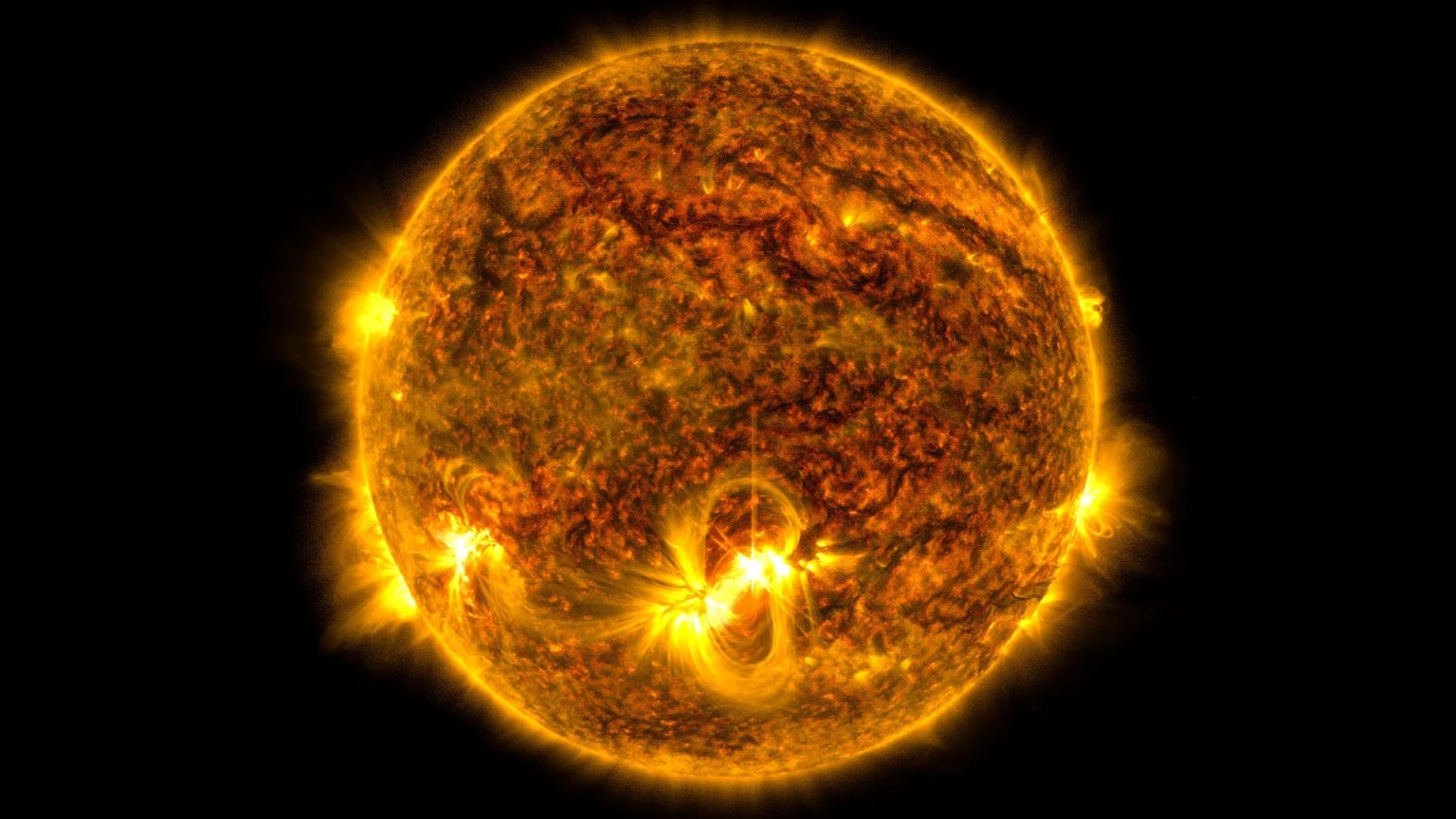
In this GIF, a mottled yellow Sun rotates against a black background. The surface shows activity like flares.
The Solar Dynamics Observatory captured this ultraviolet view of our Sun from its orbit around Earth.
NASA’s Scientific Visualization Studio/SDO

A low-mass star has a mass eight times the Sun’s or less and can burn steadily for billions of years. As it reaches the end of its life, its core runs out of hydrogen to convert into helium. Because the energy produced by fusion is the only force fighting gravity’s tendency to pull matter together, the core starts to collapse. But squeezing the core also increases its temperature and pressure, so much so that its helium starts to fuse into carbon, which also releases energy. The core rebounds a little, but the star’s atmosphere expands a lot, eventually turning into a red giant star and destroying any nearby planets. (Don’t worry, though, this is several billion years away for our Sun!)

A red, glowing star starts out small and starts to grow, eventually taking up the entire frame. As the star grows, a small planet first skims the surface of the star on the left, creating a fiery skid mark. But then the star overtakes the planet, engulfing it completely in a small orange blip.
In this visualization a red giant star swallows a planet.
NASA/JPL-Caltech/D. Berry

Red giants become unstable and begin pulsating, periodically inflating and ejecting some of their atmospheres. Eventually, all of the star’s outer layers blow away, creating an expanding cloud of dust and gas misleadingly called a planetary nebula. (There are no planets involved.)
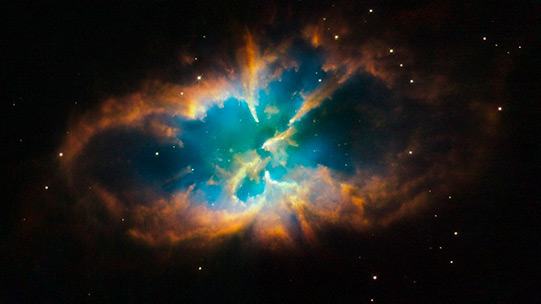
This planetary nebula, known as NGC 2818, takes up the entire frame. It is surrounded by an orange oval of wispy clouds shaped almost like lips. Inside the oval is a bright blue cloud pierced by a few small spikes of the orange clouds.
The planetary nebula designated NGC 2818, lies in the southern constellation of Pyxis. The colors in the image, captured by the Hubble Space Telescope, represent a range of emissions coming from the clouds of the nebula: red represents nitrogen, green represents hydrogen, and blue represents oxygen.
NASA, ESA, and the Hubble Heritage Team (STScI/AURA)

恒星留下的只有它的核心,现在被称为white dwarf,这是一块大约地球大小的恒星余烬,会在数十亿年里逐渐冷却。如果你能舀起一茶匙它的物质,重量会超过一辆皮卡车。

This GIF starts with a size comparison between a possible giant planet and the white dwarf that it orbits. The planet is shown as a striped, pink orb and it is nearly seven times larger than the bright white dwarf star. The animation then pulls out to show the relative size of the orbit of the white dwarf and its planet.
一颗可能的巨行星也许在其微小恒星混乱的历史中幸存了下来。木星大小的WD 1856 b比它每1.5天环绕一周的白矮星大了近七倍。天文学家利用NASA的凌星系外行星巡天卫星和现已退役的斯皮策太空望远镜的数据发现了它。NASA戈达德太空飞行中心

大质量恒星

high-mass star的质量是太阳的八倍或更多,可能只存活数百万年。(下图中猎户座的蓝超巨星参宿七,质量是太阳的18倍。)
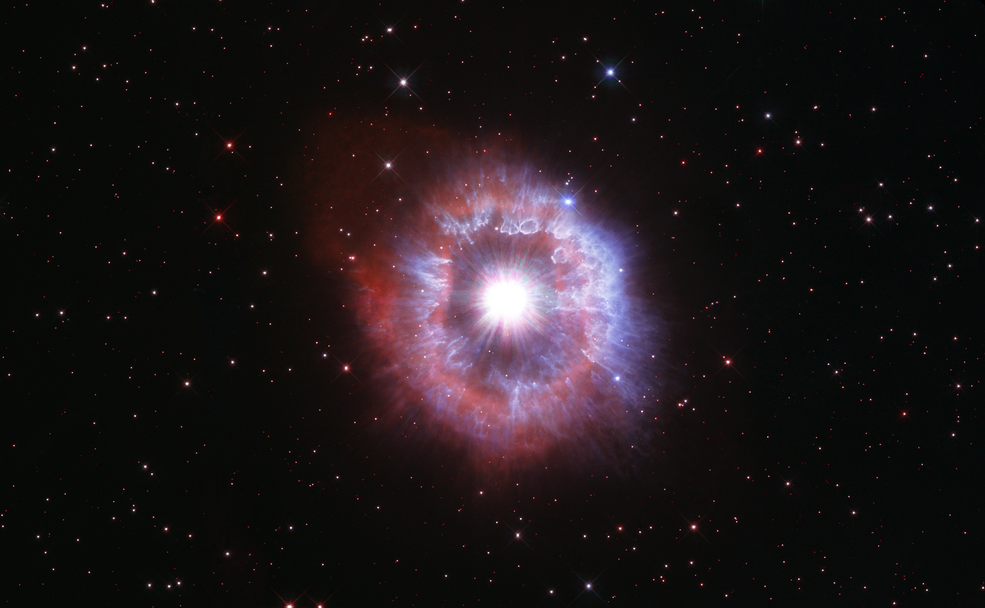
AG Carinae
这张由哈勃太空望远镜拍摄的AG Carinae,是一颗濒临坍缩的巨星。NASA、ESA、STScI

恒星的铁核会collapses,直到原子核之间的力踩下刹车,然后它又反弹回原来的大小。这一变化产生一道冲击波,穿过恒星的外层。结果就是一场被称为supernova的巨大爆炸。

This visualization opens on a star field with a bright star at the center of the image. The star then explodes, filling the frame with white light for a moment. As that bright light fades, we see there is a bubble of yellow and red material expanding away from the site of the exploded star.
当一颗质量是太阳八倍的恒星结束生命时,它不会温和地走进那个良夜。其核心不断变化的压力使它坍缩并引发超新星爆发——宇宙中最大的爆炸。最初的光闪可能只持续几秒钟,却可能比恒星所在的星系还亮。但被抛入太空的碎片可以被研究数千年。由ESA/哈勃/L. Calçada提供

What’s left behind depends on the star’s initial mass. Remember, a high-mass star is anything with a mass more than eight times the Sun’s — which is a huge range! A star on the lower end of this spectrum leaves behind a city-size, superdense neutron star. (Some of these weird objects can spin faster than blender blades and have powerful magnetic fields. A teaspoon of their material would weigh as much as a mountain.)

This simulation shows the possible arcs of magnetic field lines from a pulsar. At the center is a gray orb representing the pulsar. Close to the pulsar are various-sized ovals of orange that pierce the pulsar, looking like a tangled knot, though the lines do not actually cross each other. There are larger blue arcs that come off the screen, representing even more magnetic field lines.
一个脉冲星可能的四极磁场构型模拟,其热点仅出现在南半球。NASA戈达德太空飞行中心

At even higher masses, the star’s core turns into a black hole, one of the most bizarre cosmic objects out there. Black holes have such strong gravity that light can’t escape them. If you tried to get a teaspoon of material to weigh, you wouldn’t get it back once it crossed the event horizon — unless it could travel faster than the speed of light, and we don’t know of anything that can! (We’re a long way from visiting a black hole, but if you ever find yourself near one, there are some important safety considerations you should keep in mind.)

In this data visualization, material swirls around a black hole, but our line of sight skews our view of the disk. The center of the image is a black hole, with a thin ring of orange around it, then a small gap, and then a striped disk of material. The disk in front of the black hole appears as we would expect, with the disk arcing in front of the black hole like a flat pancake. However, the far side of the disk is visible above and below the black hole, instead of being blocked by the black hole. This is due to the black hole’s gravity, which redirects the light up and over the black hole on its path to us.
This visualization of a black hole illustrates how its gravity distorts our view, warping its surroundings as if seen in a carnival mirror.
NASA’s Goddard Space Flight Center/Jeremy Schnittman

The explosion also leaves behind a cloud of debris called a supernova remnant. These and planetary nebulae from low-mass stars are the sources of many of the elements we find on Earth. Their dust and gas will one day become a part of other stars, starting the whole process over again.

That’s a very brief summary of the lives, times, and deaths of stars. (Remember, there’s that whole intermediate-mass category we glossed over!)

Keep Exploring

探索更多来自 NASA 的主题

内容镜像自 NASA(public domain),中文译文由 AI 辅助生成、仅供参考。